
Why your backyard floods after Perth rains (and what fixes it)
Every May, the calls start. The first decent Perth winter rain falls and half the backyards in the metro turn into puddles that don't drain. The fix isn't a bigger pump or a deeper hole — it's usually a soakwell that's failed, undersized, or never built right in the first place. Here's how to read the symptoms and what it actually takes to fix it.
Why Perth backyards flood
Perth sits on a mix of coastal sand and clay-loaded inland soils. The water table runs high in winter — sometimes within a metre of the surface in suburbs like Bayswater, Bassendean, Riverton. Stormwater either soaks into the ground via a soakwell or runs off to the street. When the soakwell can't take the volume, water backs up.
Four common causes:
- Undersized soakwell. Old houses often have a single 1.2m × 0.9m soakwell doing the job of three or four. Worked fine in 1985; doesn't work now with extensions, paving, and a doubled roof area feeding into it.
- Collapsed or silted soakwell. Concrete liner cracks, sand fills it, stormwater has nowhere to go.
- Blocked downpipe runs. Tree roots in the pipes, sediment build-up, crushed PVC. Water can't get to the soakwell.
- High water table in winter. The soakwell's working, but the ground around it is already saturated. Even properly sized soakwells back up if the water table's at chamber level.
Signs your soakwell has failed
You don't need a camera down the pipe to spot it. Look for:
- Water pooling in the same spots every time it rains
- A sinkhole or depression forming over where the soakwell sits
- Water overflowing from downpipes during heavy rain
- Backyard turning to mud and staying that way for days after rain stops
- Driveway puddling that drains to the lawn, not to the street
- That musty, wet-earth smell coming from the side path
One or two of these in a once-a-decade storm is normal. All of them in a routine winter downpour means the system isn't coping.
How to inspect your stormwater system
What you can check yourself, in about 30 minutes:
- Walk the downpipes. Are they connecting to PVC that runs underground? Or just spilling onto the paving?
- Find the soakwell. Usually a concrete or brick lid in the lawn, sometimes under a paved area. Older blocks have them set in obvious circular depressions.
- Lift the lid (carefully). If it's full of standing water 12+ hours after rain stops, it's not draining.
- Check inlet pipes. Visible from inside the chamber — they should be clear, not full of mud or roots.
Anything past that — root invasion, chamber cracks, undersizing — needs a dig to confirm.
Soakwell sizing for Perth
Rule of thumb under most Perth council requirements: 1m³ of soakwell capacity for every 25–35m² of impervious surface draining into it (roof, paving, concrete). Local councils vary — check yours.
For a typical Perth single-storey home:
- Roof area: 180–250m²
- Required soakwell volume: 5–9m³ minimum
- That's usually 2–4 standard 1.2m × 0.9m precast soakwells (each chamber holds about 1.0m³)
Two-storey homes, larger blocks, and homes with significant paving need proportionally more. New builds usually get speced to council requirements; renovations and extensions often don't. That's where the failures come from — the original soakwell sized for the original roof, never upgraded when the extension went on.
What's actually involved in a soakwell install
Whether it's a single chamber replacement or a full new drainage system, the scope of work usually covers:
- Locating and exposing the existing chamber (if there is one). Often a blind dig until the lid shows up.
- Dig out and remove the failed chamber. Concrete liners are heavy and brittle — needs proper rigging if you're keeping the surrounds intact.
- Supply and install of new precast soakwells. Sized to the catchment (roof + paving) the system is feeding.
- New or rerouted PVC pipe runs. Graded properly so water actually flows to the chamber, not back to the house.
- Backfill and reinstate. Sand bedding, mechanical compaction, surface restoration where the dig opened up lawn, paving, or driveway.
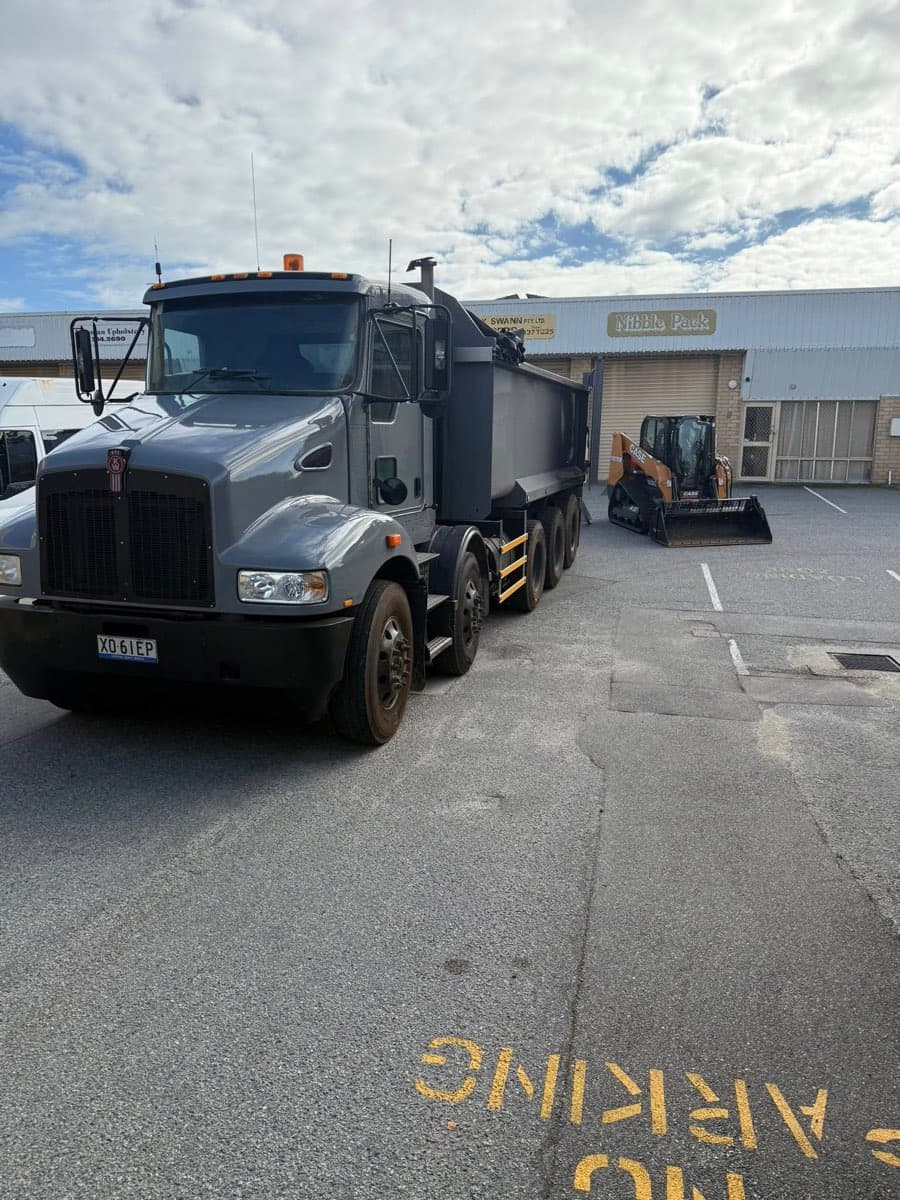
On the price side: depth to inlet, tree roots in the dig, paving or concrete that needs cutting up first, and tight access (where a mini-excavator and dumper relay is needed instead of drive-in) all push it up. Free site visit gives the real number for your block.
Common drainage installation mistakes
Wrong depth on the soakwell
Too shallow and you hit the chamber lid with a mower. Too deep and you've buried the inlet too low — water sits in the pipes after rain stops and that's how root invasion starts. Standard install puts the lid 100–150mm below finished surface.
Inlet pipes graded the wrong way
PVC has to fall towards the soakwell at 1:100 minimum. Reverse-fall is shockingly common in DIY jobs and renovation rushes. Water sits in the pipe, sediment builds up, the system clogs.
No overflow path
In a 1-in-20-year storm, even a properly sized soakwell can overflow. A surface overflow path (a swale to the street, or a secondary chamber) keeps it from coming up through your back door instead.
Soakwell installed in clay without consideration
Some inland Perth suburbs sit on heavy clay. A soakwell installed without a sand-and-gravel surround in clay can take 24+ hours to drain even when working "correctly". Engineered solutions exist — agi pipe runs, infiltration trenches — but they cost more than the standard install.
When to act
If your backyard's flooded once or twice in a wet winter, you've probably got a year before it becomes a real problem. If it's flooding every storm, every winter, and the house is built on clay — the soakwell's already failed and the longer it sits, the more ground saturation you're working with. Pumps don't fix it. Bigger drains don't fix it. Properly sized soakwell capacity does.
Have a look at our stormwater drainage and soakwell installs — we run the dig, the precast supply, the pipe work, and the reinstate. Free site visit to scope the system before quoting.