
Tight access pool excavation: what it is and when you need it
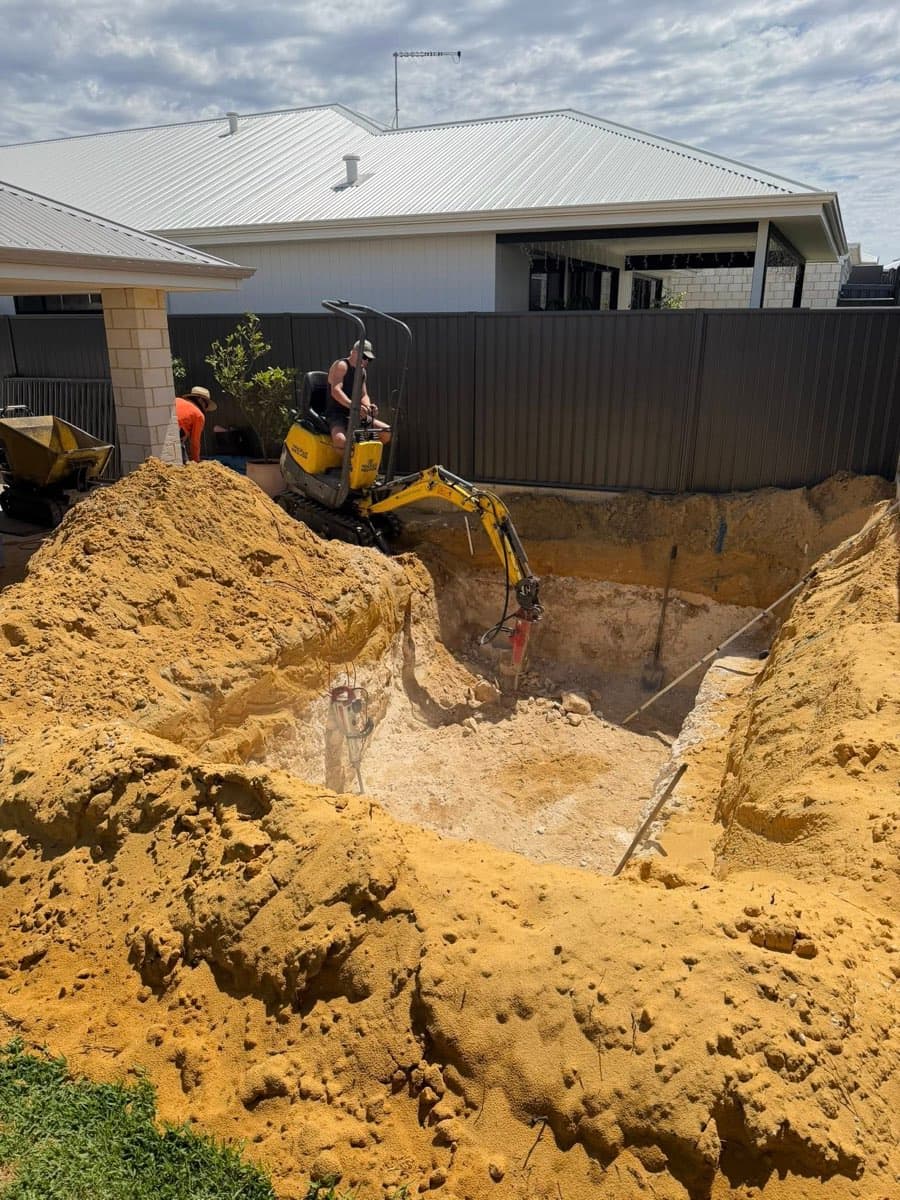
Half the pool digs we get called for in Perth start with the same line: "the other crew said they'd have to take the fence down." Usually they don't — they just don't run the gear that gets through a 750mm side gate. Here's what tight access actually means, when you genuinely need it, and how the dig runs.
What "tight access" actually means
The rule of thumb in Perth: anything under about 1.5m at the narrowest point on the access path counts as tight access. Most standard pool excavation rigs are 1.6m to 2.2m wide — a regular 5-tonne machine simply won't fit through a 1.1m side gate.
A proper tight-access setup uses a mini-excavator with a tracked footprint between 760mm and 990mm wide. Pair it with a motorised dumper at similar width and you've got a crew that fits gaps from 750mm — including most timber paling gates, brick pier openings, and a fair few courtyard archways.
Rough test: if you can roll a standard council wheelie bin through the gap with a hand on each side, our setup usually fits. Worth checking before assuming you need fence removal.
Why standard pool excavators can't fit through most Perth side gates
The maths is simple. The 3–5 tonne excavators most Perth pool diggers run measure 1.6m to 2.0m across the tracks. Add an operator-protection cage and you're closer to 2.1m. A standard Perth residential side gate is typically 900mm to 1.2m. Most blocks built since 2000 have side passages narrower than that.
When the gear doesn't fit, the standard plan is "we'll take the fence down." Fair enough on some jobs — sometimes the fence is dropping anyway, sometimes it's old and overdue. But it's not the only option, and it shouldn't be the default.
How a mini-excavator and dumper crew actually works
A tight-access pool dig usually runs like this:
- Mini-excavator goes in through the gate first, tracks lightly, leaves a clean line
- Motorised dumper follows — about the same width, carries 1–1.5 tonnes of spoil at a time
- Tipper truck parks on the verge or driveway; dumper relays spoil out to the tipper
- Excavator works the pit, dumper shuttles, tipper hauls full loads to a Perth tip
- Once the hole's down to depth, mini-excavator squares the corners, hand-trim where needed
Standard pool dig that takes a regular crew a day becomes a 3–5 day job at this scale. The mini-excavator buckets less per pass, the dumper relays add time, but the trade-off is you keep the fence, you keep the garden bed, you keep the verge intact, and the neighbours don't lose their afternoon.
What kind of Perth properties actually need tight access
Infill blocks
Subdivided rear lots are the classic tight-access job. House at the front, narrow shared driveway, the pool's going in the rear yard. Side access through a 900mm pedestrian path is usually all you've got.
Courtyard pools
Older inner-Perth suburbs (Subiaco, North Perth, Mt Lawley) often have walled courtyards with a single 800mm arched entry. Standard rigs are a non-starter. Tight access is the only practical option.
Terraced and townhouse blocks
Shared rear lanes, narrow side passages, brick pier gates — the standard fit-out of newer higher-density blocks. The dig has to fit the access; can't widen the access.
Heritage and council-protected verges
Some western-suburbs streets (Cottesloe, Peppermint Grove) have heritage verge trees you can't drive heavy gear over. Tight access keeps everything on the residential side of the fence.
Routing spoil out without a truck on site
On the tightest jobs the tipper truck can't even park at the gate — it has to sit on the verge or the kerb. The dumper does a constant relay between the pit and the truck.
For a 60m³ pool that's 40–50 dumper trips. Sounds like a lot, and it is — but it's the reason the dig still gets done on a block standard rigs can't enter. The alternative isn't "do the dig faster", it's "don't do the dig at all without removing the fence."
What you save by keeping the fence up
Dropping the side fence to fit a standard rig means stacking up:
- A fencer to remove the panels and store them somewhere
- Reinstatement after the dig — new fixings, sometimes new posts
- Damage replacement if anything cracks during removal or storage
- The neighbour's lost privacy for two to three weeks
- The conversation with the neighbour about the lost privacy
Tight-access pricing is higher than a standard dig — but once you add up the fencer's bill, the storage, the reinstate, and the time, it's often a wash on dollars. You don't deal with fence-out-fence-back-in stress, and you don't owe the neighbour a six-pack.
When tight access is overkill
If you've got a 3m gate, rear-lane access, or a corner block where a truck can back straight to the pit, you don't need tight-access pricing — a standard rig is faster and cheaper. We'll tell you that on the site visit. The 750mm setup isn't always the right answer; it's the right answer when the access is genuinely tight.
For typical Perth pool-dig pricing — standard and tight access — have a read of how much does pool excavation cost in Perth in 2026.