
How much does pool excavation cost in Perth in 2026?
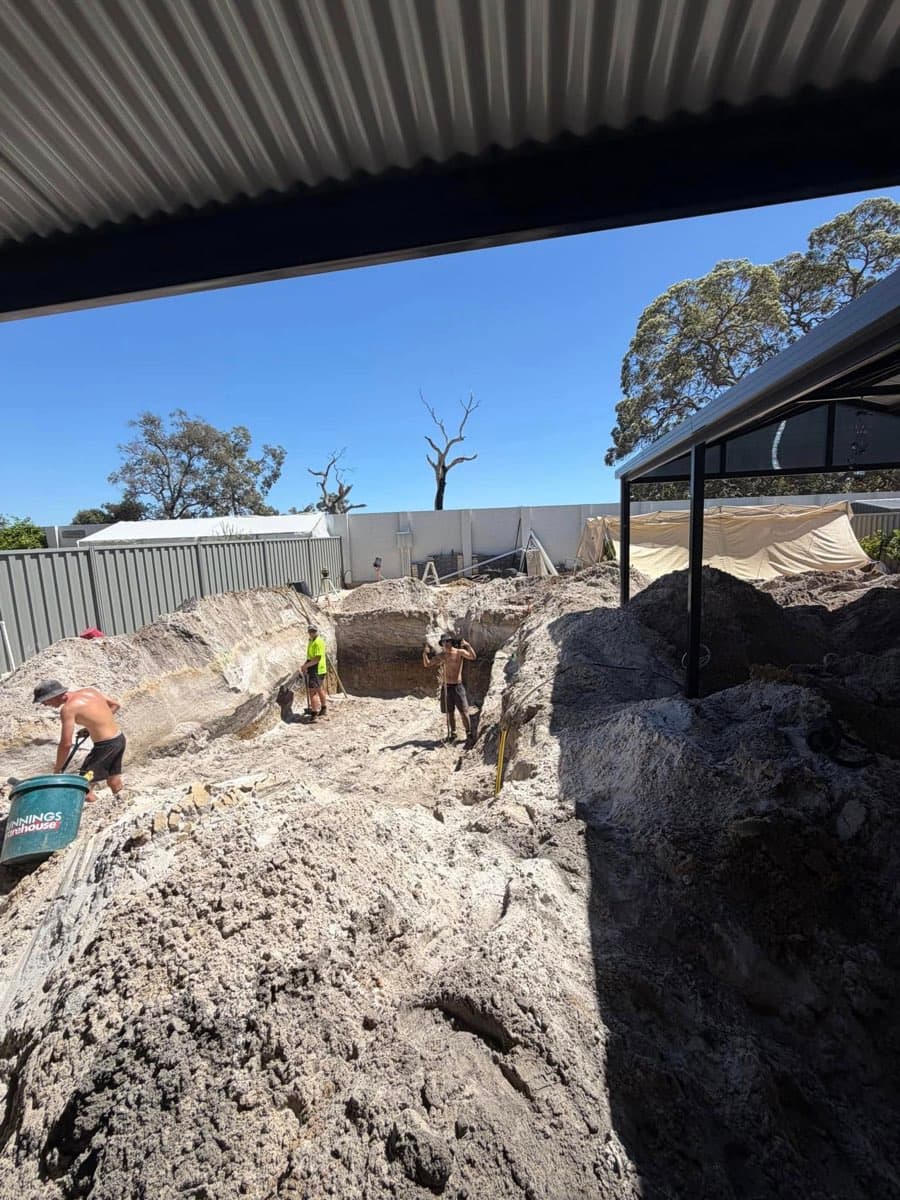
If you've rung around for a pool excavation quote in Perth, you've probably copped three wildly different numbers and zero explanation for why. Here's what actually drives the price, what's standard, and what blows the budget — based on what we see week to week digging pools across Perth metro and south.
The honest quick answer: it depends — and here's why
We don't publish prices because no two Perth pool digs are the same. The same 8m × 4m pool can be a one-day job on one block and a five-day job on the next door over. What changes the number is access, soil, volume, and what's already under the ground.
What we can tell you is what drives the price up or down. Read on, work out which buckets your job sits in, then call for a real number — free site visit, fixed price in writing within 48 hours of the visit.
What's included in a clean fixed-price pool excavation quote
A proper quote should cover all of this without an asterisk:
- Excavator and operator on site for the dig (sometimes two days)
- Spoil loading and trucking off-site
- Set out and benchmarking from the pool engineer's drawing
- Tip fees at a Perth dump
- Public liability and workers' insurance
- Dial Before You Dig referral and on-site service location
- Site left clean and ready for the form crew or fibreglass install
What's usually not included unless your quote spells it out:
- Rock breaking (if you hit limestone or ironstone)
- Tree or stump removal
- Fence removal and reinstatement
- Lawn or pavement reinstatement
- Asbestos disposal (specialist licensed disposal required)
Five things that blow the pool-dig budget
The difference between a smooth fixed-price dig and a runaway bill is almost always one of these:
1. Rock or hard limestone
Perth coastal suburbs sit on limestone that can range from soft and friable to bucket-bouncing hard. A rock breaker attachment chews through it, but each cubic metre takes longer and burns more gear. A test dig before quoting tells us — and you — what we're actually digging.
2. Asbestos in the fill
Older Perth blocks — anything pre-1990 with renovated yards — can have buried asbestos sheet fragments. Find it mid-dig and work stops until a licensed removalist clears it. Adds days, not hours, and the disposal goes through a specialist facility. Worth knowing your site history before booking.
3. Sand collapse and shoring
Coastal sand blocks (Cottesloe, Mosman Park, Scarborough) can have loose sand that collapses inward as you dig. Shoring boards or a battered profile fix it, but both add time and machine hours. Your pool engineer's drawing will usually flag if shoring's needed.
4. Fence and access drama
If your only way in is to drop the side fence, you've added fencer hours, neighbour coordination, and reinstatement time on the back end. A tight-access mini-excavator setup is often a better answer — same dig, fence intact. More on this in tight access pool excavation explained.
5. Wet ground in winter
Perth winter pool digs in clay-heavy suburbs (Mt Lawley, Inglewood, Mt Hawthorn) can need pumps running while you work. Each rain day pushes the program out. Schedule winter digs knowing weather can add 10–20% to the time on site.
Standard access vs tight access — what changes
Standard access means a 3m+ side gate or rear access where a 3–5t excavator can drive in and a tipper can back up to the spoil pile. One or two days on site and you're done. It's the cheapest pool dig you'll get in Perth.
Tight access means anything under about 1.5m at the narrowest point — side gates, courtyards, alley blocks, around-the-house digs. A 0.8t to 1.7t mini-excavator goes in, spoil comes out by motorised dumper relay to a tipper parked on the verge. Takes longer than a standard dig — 3–5 days is typical — but it's the only way to dig some blocks without taking the fence down.
Our tight-access pool excavation setup fits gaps from 750mm — handy when standard pool rigs are quoting fence removal as part of the job.
Concrete vs fibreglass — does it change the dig?
Yes, more than most people think.
Concrete pools are usually rectangular with battered sides (a slight outward slope) to suit shotcrete crews. Dig volume on a standard 8 × 4 × 1.8m pool runs around 60–70m³. Tolerances are forgiving — the form crew tightens up the shape.
Fibreglass pools are dug to the shell. The shape is fixed and the tolerances tighter — over-dig past the shell footprint costs you in backfill. Volume is usually 10–20% less than the concrete equivalent because there's no batter. On a tight access job, that's a day off the dumper time and a noticeable line on the quote.
Spoil removal — in or out of the quote?
Pool dig spoil is usually 60–80m³ of sand or clay. That's 4–6 truckloads in a 5-tonne tipper, plus dump fees at a Perth tip. Some excavators quote the dig only and leave you to sort spoil — fine if you've got somewhere to put it, painful if you haven't.
We bring the tipper and the spoil leaves with us same day. One quote line, one invoice, no leftover pile on the lawn.
How to get an accurate pool excavation quote
Three things make the difference between a guess and a real number:
- Engineer's drawing or pool builder's shop drawing. Tells us the dimensions and the dig volume.
- Photos or a quick video of the access. Side gate width, any overhanging eaves, anything we'd need to duck under.
- Soil type if you know it. Sand, limestone, clay, or fill. Changes the machine choice and the time on site.
Once we've got those, a free site visit confirms it. Fixed price in writing within 48 hours of the visit. Truck and bobcat included. No "we'll see how we go" extras at the end.